
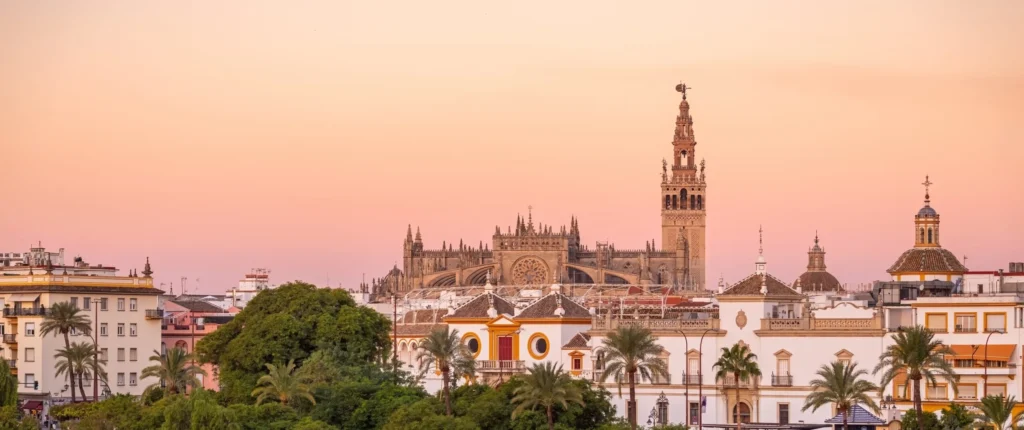
STUDY ABROAD IN
SEVILLE

CHANGE YOUR WORLDVIEW in Seville
Study abroad in Seville and explore Spain’s historic, welcoming culture in one of its most popular cities. Discover local wine and tapas, delight in 300 sunny days per year, and immerse yourself in a place where life happens at a slower pace, with long dinners, new friends, and conversations that run late into the night.


Dates & Deadlines
- Spring ’27: Feb. 9 – May 22 (Enroll by Nov. 16, 2026)
- Fall ’27: Late August – Early December
Reminder: Locations have limited capacity and spots can fill quickly.
Requirements
- Fall Semester Abroad: Must be 18 by June 1
- Valid Passport
- Country-specific Visa (additional cost)
Program Cost
- Fall ’26 & Spring ’27: $22,500 before study abroad scholarships or grants
- Fall ’27 & Spring ’28: $23,750 before study abroad scholarships or grants
College Credits
- 12-17 Credits from our Academic Provider, the University of New Haven
Accommodations
- Homestays or Student Residence
HOW TO STUDY in Seville
Students have several options to study in Seville. The best fit depends on your budget, goals for credit hours and school, and how long you’d like to stay abroad.
Here’s a quick walk-through on how to study in Seville:
1. Apply Directly to a University in Seville
Universities in Seville may include the University of Seville, Pablo de Olavide University, and Loyola University Andalusia.
- Complete immersion in Spanish life and university.
- Students have the opportunity to build long-term relationships, study Spanish in Seville, and live in the city full-time.
- Studies will be more expensive over time. These expenses can include visa fees, moving costs, and the added expenses of living overseas for multiple years.
- Students must complete applications and visa processes independently.
- It’s harder to leave Seville during your studies and offers less flexibility.
- If you decide to leave, transferring college credits to other U.S. universities may be difficult.
2. Standard Study Abroad Programs (Run by U.S. Universities)
A semester or year in Seville through your U.S. college.
- Apply through your university with support from the study abroad office staff.
- You may qualify for study abroad scholarships through your university.
- Programs typically have more competitive entry because many students apply to study abroad programs through their university.
- There’s no guarantee you’ll receive entry even after application.
- Different grading structures can affect your final degree classification.
3. Apply to Verto’s Program in Seville
Start your first year in Seville – no prior enrollment required.
- Apply to Verto’s semester in Seville in a few minutes and get matched with a personal counselor.
- Receive personalized support from a counselor and from professors and staff in Seville.
- Spend a semester abroad, then resume your studies at a university in the U.S.
- Earn 12 to 17 transferable credits from Verto’s Academic Provider (the University of New Haven) and easily transfer them to your university.
- Typically more affordable for students than spending multiple years or a full year abroad.
- Students cannot complete a full four-year degree in Seville, but can still spend one to three semesters abroad through Verto’s study abroad programs.
Visa Process to Study Abroad in Seville
Verto’s study abroad program in Spain requires a visa application. Applying for a student visa in Spain is a multi-step process, but we’re here to guide you through every step.
Basic Passport Requirements
- Passports must be valid for at least 1 year after the program start date.
- Passports must be in good condition (no rips, tears, stains, etc.).
Seville Visa Application Process
- Start by visiting the Seville student visa information on our location resources page.
- Watch the “Spain Student Visa Overview Video” to get started.
- Decide if you will submit your visa as part of the Group Appointment with Verto or to a BLS Spain Visa Application Center on your own.
- Gather your documents, pay the visa fee, and submit all documents to your selected office (Verto’s Group Visa Application or a BLS Spain Visa Application Center). Keep in mind that consulates have different submission requirements, and you’ll need to access the specific BLS documents to verify what you must submit.
Seville Neighborhoods
Seville may not be one of Spain’s biggest cities, but its neighborhoods are home to unique personalities, and there are many great spots to explore or call home.
Popular Seville neighborhoods include:
- Santa Cruz: Considered the true heart of Seville, Santa Cruz is the old Jewish quarter with historic churches, cafes, shopping, restaurants, and more. The Royal Alcazar of Seville, the great palace of the city, is here, and this neighborhood is only a 10-minute walk to Verto’s study center.
- Centro: Seville’s historic center, Centro is home to some of the top tourist attractions, shopping, and quintessential Spanish architecture. As a bonus, Verto’s Education Study Center is just a few minutes outside of Centro, in El Arenal.
- Triana: Did someone say flamenco? Triana is best-known for its connection to Seville’s flamenco community. Nightlife is a big part of this neighborhood, and drinks and tapas can be found around every corner.
- El Arenal: Life happens in El Arenal, and its main draws are the busy clubs and bars, fresh restaurants, and nightlife that welcomes all of Seville. Verto’s Education Study Center is in El Arenal, meaning you’d have an extremely short commute to the program.
- Macarena: At the top of the city, you’ll find Macarena, a working-class neighborhood. It places equal emphasis on tapas and bars, as well as its many important monuments and churches.
- Alfalfa: Students seeking a more authentic vibe and the “real” tapas experience can look to the Alfalfa neighborhood. There’s also an abundance of shopping, cafes, and other modern exhibitions.
- El Porvenir: As a new trending area of Seville, El Porvenir is known for its dining, proximity to the Parque de María Luisa, and tapas and bars to grab drinks with your friends.
- Regina: Revived with help from the city, Regina is a unique urban spot known for its bohemian vibes. Dining options are also a major selling point of this neighborhood, and there are affordable grocery stores nearby.
- Feria & Alameda: Positioned right next to each other, Feria and Alameda are best known for the same things: the top vintage and retro shops, bars that stay open late into the night, and easy access to good food.
WHAT WILL MY LIFE LOOK LIKE in Seville
In Seville, life is all about making connections. You may spend the morning practicing your Spanish while assisting the elderly at a nursing home or spend time as an English language assistant at a local K-12 school.
You don’t have to spend all your free time volunteering, though. Seville is a little over an hour from the coast, where you will find stretches of sandy beaches or national parks for you to explore and venture with friends.
After busy days of studying, volunteering, or exploring, you can enjoy tapas with friends at local restaurants or browse local boutiques for the best clothes and accessories Seville has to offer.

Excursions & Activities
Possible Study Abroad Excursions:

Day Trips: From Seville, you can easily reach other cities like Cordoba, where you can explore the mosque cathedral and walk amongst the medieval streets, and Cadiz, where wanderers climb the bell tower and navigate the city by bike. A day trip to Mérida allows you to explore Roman ruins, as it has the most ruins in all of Spain.
Cultural Experiences: Step inside history at the Cathedral de Sevilla and Royal Alcázar of Seville. Climb the Giralda Tower or visit museum favorites like the Museum of Fine Arts. There’s no shortage of cultural experiences in Seville, and all you have to do is step outside to fall into real Spanish experiences.
Outdoor Activities: Within the city, you can explore one of its three main parks: Alamillo Park, Parque Miraflores, and Parque de María Luisa. From Seville, there is also a national park about an hour away, Parque Nacional de Doñana, a wetland reserve with hiking and sweeping nature views.
Excursions are subject to change based on availability each semester, ensuring a dynamic and enriching experience.


Accommodations
& Meals
Find Your Home Base in Seville, Spain
Students studying in Seville can live in a student residence or have an authentic Spanish experience at a local homestay.
Verto Seville Study Center
Verto’s Seville study center is located in El Arenal, one of the city’s most active hubs. After a quick breakfast, you can walk from your student residence or homestay to the neighborhood. Once your courses end, head out to volunteer in the community, then catch up with friends over tapas at a local bar in a charming part of the city.
ACADEMICS in Seville
During your Seville study abroad program, you’ll earn transferable college credits from Verto’s Academic Provider, the University of New Haven.
Verto’s Exceptional Academic Experience:
Intimate Class Sizes: Receive personalized support and attention from professors and staff in absorbing learning environments. Classrooms have an average size of 16 students.
Excursions with Hands-On Learning: Learning extends beyond the classroom walls through excursions that take you through Spain’s culture and history, featuring hands-on activities.
Consistent Academic Support & Advising: You won’t have to navigate the program alone. As you study in Seville, you’ll get personalized support paired with 1:1 guidance for academics as well as access to resources like tutoring and study groups.
Course Information
Advanced Spanish
This course is intended to develop students’ proficiencies in speaking, writing, listening, and reading so that they can be at a level necessary for advanced literature and culture courses. It will emphasize composition and oral discussion as well as concepts necessary for a sophisticated appraisal of literature and culture in the target language. This course will be conducted in the target language.
Biology I: Molecular Basis of Life w/ Lab
Part of a year-long foundation course for science majors. The course explores the principles of biological organization with an emphasis on cell structure and function. Topics covered include molecular cellular organization and function, gene expression, cellular division, genetic inheritance, and processes involved in the synthesis and metabolism of carbohydrates.
Calculus I
The first year college course for majors in mathematics, science and engineering; and the basic prerequisite for all advanced mathematics. Introduces differential and integral calculus for functions of one variable, including algebraic and transcendental functions and culminates in the fundamental theorem of calculus. Includes basic rules and properties of limits and derivatives and applications of derivatives. Studies the plane analytic geometry needed for calculus.
Calculus II
Continuation of first year calculus, including the fundamental theorem of calculus, methods of integration, applications of the integral, improper integrals, infinite series, and introduction to differential equations.
College Algebra
A review of the fundamental operations and an extensive study of functions, exponents, radicals, linear and quadratic equations. Additional topics include ratio, proportion, variation, progression and the binomial theorem. This course is intended primarily for students whose program of study requires calculus or business math.
Contemporary Social Problems
The major problems which confront the present social order, and the methods now in practice or being considered for dealing with these problems.
Cultural Anthropology
A systematic study of the culture of preliterate and modern societies and of cultural change. Includes analyses of religion, economics, language, social and political organization and urbanization.
Elementary Spanish I
Focuses on the fundamental principles of grammar. Extensive vocabulary and pronunciation exercises.
Elementary Spanish II
Focuses on the fundamental principles of grammar. Extensive vocabulary and pronunciation exercises. Aural comprehension and pronunciation are tested by oral examination.
Elementary Statistics
Topics include: basic probability theory; random variables and their distributions; estimation and hypothesis testing; regression; and correlation. This course is not calculus-based, and places an emphasis on an applied approach to statistical theory with applications chosen from the biological sciences and other fields of study. Students will be introduced to and make use of a computer package for data analysis.
Foundations for Success
Foundations for Success is a unique one-credit course designed with the purpose of guiding students through the transition between high-school and college life. With a focus on developing essential skills that are integral for success both in and beyond the classroom, this course will equip first-year students with the tools necessary to thrive academically, socially, and personally. Our holistic approach recognizes the importance of intellectual, emotional, social, ethical, and physical development, making this course a powerful tool for growth and self-awareness. Through interactive coursework, students will learn how to cultivate lifelong learning skills, foster community, build resilience, and achieve personal success at every level.
Foundations of Leadership
This course introduces students to the history of leadership and provides the opportunity to explore leadership theory and concepts through the six competencies of the Competency Learning Experience (CLE): (1) leadership, (2) communication, (3) resilience, (4) teamwork, (5) global and cultural awareness, and (6) critical thinking. Through engagement with interactive assignments, case studies and class discussions, students will develop skills to improve their understanding of leadership and how to be effective leaders in their organizations, teams, communities, and careers.
General Chemistry I w/ Lab
This course discusses atomic and molecular structure, chemical bonding, stoichiometry, states of matter, and thermo-chemistry. This course includes a lab that introduces basic laboratory techniques and emphasizes data collection and analysis.
General Physics I w/ Lab
Primarily for life science majors with no calculus background. Basic concepts of classical physics: fundamental laws of mechanics, heat, electromagnetism, optics, and conservation principles. Introduction to modern physics: relativity and quantum theory; atomic, nuclear, and solid-state physics. Application of the physical principles to life sciences.
History of Art II
This course introduces students to works of art from the Renaissance period to the mid-20th century. The course explores the expressive, social, cultural, political, economic, and technological aspects of societies as reflected in their art.
Intermediate Spanish I
Stresses the reading comprehension of modern prose texts and a review of grammar necessary for this reading. Students are encouraged to read in their own areas of interest.
Intermediate Spanish II
Stresses the reading comprehension of modern prose texts and a review of grammar necessary for this reading. Students are encouraged to read in their own areas of interest.
International Relations
Forces and structures operating in the modern nation-state system, the foreign policy process, decision-making process, the impact of decolonization on traditional interstate behavior, economic and political developments since World War II.
Introduction to Business and Entrepreneurship
This course provides a framework for students to understand the decision-making processes, and related strategies, followed by an entrepreneur or business start-up. The course will introduce students to business fundamentals while they synthesize information from multiple sources to solve a business problem or opportunity. Students will use elements of design thinking and work in teams to design a business plan. Students will concurrently learn the language of business, while they build business communication skills.
Introduction to Microeconomics
Microeconomics including markets and market structure and the allocation of resources. The distribution of income, the public economy, the international economy, and selected economic problems.
Introduction to Music
Basic forms and styles of music in the Western World; music appreciation.
Introduction to Psychology
This course will provide students with a basic understanding of psychology as a science. It will introduce students to research methods, principles of learning, development, biological bases of behavior, psychological disorders, and social psychological phenomena. Additional topics may include cognition, sensation and perception, sleep, intelligence, and personality. Ethical issues within the field will also be examined.
Mechanics, Heat, and Waves w/ Lab
A first semester, calculus-based physics course for physical science and engineering majors. Fundamentals of mechanics and thermal physics. Vectors, kinematics, Newton’s laws, conservation principles for energy, momentum, and angular momentum, linear, rotational, and harmonic motion, superposition principle, gravitation, fluids, mechanical waves, sound, heat, ideal gases, laws of thermodynamics.
Modern Societies and Civilizations
In this course students will explore selected societies and civilizations from the sixteenth through twentieth centuries. This will include major cultural trends, interactions between society and economy, and analysis of cooperation and competition within and between various communities.Students will develop an understanding and appreciation of various cultures that shaped modern societies as parts of our shared human story. Examination of what it has meant to be human in diverse circumstances will provide students with powerful tools for better engaging their world today, and planning for our future. Amongst an array of methods for historical analysis, students will receive training in various methods of computer-based data analysis, visualizations, and professional presentation - transferrable to any profession.
Philosophy of Religion
An examination of some philosophical notions used in religious discourse, such as meaning, truth, faith, being, God, the holy.
Pre-Calculus
Topics include: polynomials; algebraic functions; plane analytic trigonometry; and properties of exponential, logarithmic, and trigonometric functions. This course offers the foundation needed for the study of calculus.
Principles of Communication
This course will cover competencies and skills necessary to effectively communicate in various settings. Specifically, the present course will address the role of verbal communication, nonverbal communication, identity, culture, and listening in multiple communicative contexts. Students will have the chance to structure, organize, develop, and present information in multiple settings. These communicative contexts include interviews, group discussions, conflict situations, and social media.
Public Speaking and Group Discussion
Development of proficiency in organizing and presenting material in speaking, group interaction, conference management, and small-group discussion.
Quantitative Reasoning
Topics include: sets; basic logic; enumeration and elementary probability; mathematical applications of personal finance; and basic statistics.
Seminar in Academic Inquiry and Writing
This course introduces students to the conventions of academic writing and the habits of critical inquiry they will need in university courses and beyond. Students read and annotate texts on a topic (or topics) selected by the instructor, develop original avenues of inquiry through classroom discussion, and transform their questions into well-supported academic arguments. Assignment sequences incorporate opportunities for research, drafting, revision, editing, and reflection to help students find writing processes that can be replicated in future courses and workplace projects that require only polished work. Because different disciplines and career paths present different scenarios for critical thinking and writing, this course also teaches students how to adapt the conventions of academic inquiry to a variety of contexts.
Understanding Media and Technology
A survey of the significant development, economics, regulation, legal issues, and content of the mass media, including newspapers, magazines, books, television, radio, sound recording, film, and Internet. Includes sections on journalistic practices and ethics, new and emerging technologies, and the role public relations and advertising plays in the media.
Advanced Spanish Conversation
This advanced course is designed to focus on students’ interpersonal, interpretative, and presentational skills, while helping them further develop their spoken level of proficiency in Spanish. Students will be exposed to the cultural diversities of the Spanish-speaking countries by means of a broad range of topics, readings, musical recordings, and films. All these elements will spark students’ imagination, will generate controversy for in-class debates, and will provide the opportunity to practice the linguistic skills needed for oral and written communication (listening comprehension, writing, reading comprehension, and socio-cultural competence).
Biology I: Molecular Basis of Life w/ Lab
Part of a year-long foundation course for science majors. The course explores the principles of biological organization with an emphasis on cell structure and function. Topics covered include molecular cellular organization and function, gene expression, cellular division, genetic inheritance, and processes involved in the synthesis and metabolism of carbohydrates.
Biology II: Organisms and Evolution w/ Lab
Part of a year-long foundation course for science majors. The course explores evolutionary theory as it applies to the diversity of life with special emphasis on animal anatomy and physiology, as well as basic ecological principles at the population, community, and ecosystem levels.
Calculus I
The first year college course for majors in mathematics, science and engineering; and the basic prerequisite for all advanced mathematics. Introduces differential and integral calculus for functions of one variable, including algebraic and transcendental functions and culminates in the fundamental theorem of calculus. Includes basic rules and properties of limits and derivatives and applications of derivatives. Studies the plane analytic geometry needed for calculus.
Calculus II
Continuation of first year calculus, including the fundamental theorem of calculus, methods of integration, applications of the integral, improper integrals, infinite series, and introduction to differential equations.
Calculus III
The calculus of multiple variables, covering three dimensional topics in analysis, linear algebra, and vector analysis, partial differentiation, maxima and minima for functions of several variables, line integrals, multiple integrals, spherical and cylindrical polar coordinates.
College Algebra
A review of the fundamental operations and an extensive study of functions, exponents, radicals, linear and quadratic equations. Additional topics include ratio, proportion, variation, progression and the binomial theorem. This course is intended primarily for students whose program of study requires calculus or business math.
Cultural Anthropology
A systematic study of the culture of preliterate and modern societies and of cultural change. Includes analyses of religion, economics, language, social and political organization and urbanization.
Differential Equations
The solution of ordinary differential equations, including the use of Laplace transforms. Existence of solutions, series solutions, matrix methods, nonlinear equations and varied applications.
Early Societies and Civilizations
In this course students will explore selected societies and civilizations from the earliest recorded histories down to the sixteenth century. This will include major cultural trends, interactions between society and economy, and analysis of cooperation and competition within and between various communities. Students will develop an understanding and appreciation of various cultures that shaped past societies as parts of our shared human story. Examination of what it has meant to be human in diverse circumstances will provide students with powerful tools for better engaging their world today, and planning for our future. Amongst an array of methods for historical analysis, students will receive training in various methods of computer-based data analysis, visualizations, and professional presentation - transferrable to any profession.
Electromagnetism and Optics w/ Lab
A second semester, calculus based physics course for physical science and engineering majors. Fundamentals of electromagnetism and optics. Electric field and potential, capacitance, resistance, direct and alternating current circuits, magnetic field, electromagnetic induction, Maxwell’s equations, electromagnetic waves, light, reflection and refraction, interference and diffraction, optical instruments.
Elementary Spanish I
Focuses on the fundamental principles of grammar. Extensive vocabulary and pronunciation exercises.
Elementary Spanish II
Focuses on the fundamental principles of grammar. Extensive vocabulary and pronunciation exercises. Aural comprehension and pronunciation are tested by oral examination.
Elementary Statistics
Topics include: basic probability theory; random variables and their distributions; estimation and hypothesis testing; regression; and correlation. This course is not calculus-based, and places an emphasis on an applied approach to statistical theory with applications chosen from the biological sciences and other fields of study. Students will be introduced to and make use of a computer package for data analysis.
Ethics
How shall one live? Critical examination of answers proposed by classic and modern philosophers of the major world traditions.
General Chemistry I w/ Lab
This course discusses atomic and molecular structure, chemical bonding, stoichiometry, states of matter, and thermo-chemistry. This course includes a lab that introduces basic laboratory techniques and emphasizes data collection and analysis.
General Chemistry II w/ Lab
The second half of a one-year course sequence in General Chemistry intended for science and engineering students and comprised of a brief overview of chemistry fundamentals including intermolecular forces, physical properties of liquids and solids, colligative properties of solutions, chemical kinetics, chemical equilibrium, solubility equilibrium, acid-base equilibrium/buffers, thermodynamics and electrochemistry.
History of Art I
This course introduces students to works of art from the Paleolithic to the Renaissance period. The course explores the expressive, social, cultural, political, economic, and technological aspects of societies as reflected in their art.
Intermediate Spanish I
Stresses the reading comprehension of modern prose texts and a review of grammar necessary for this reading. Students are encouraged to read in their own areas of interest.
Intermediate Spanish II
Stresses the reading comprehension of modern prose texts and a review of grammar necessary for this reading. Students are encouraged to read in their own areas of interest.
International Relations
Forces and structures operating in the modern nation-state system, the foreign policy process, decision-making process, the impact of decolonization on traditional interstate behavior, economic and political developments since World War II.
Introduction to Business and Entrepreneurship
This course provides a framework for students to understand the decision-making processes, and related strategies, followed by an entrepreneur or business start-up. The course will introduce students to business fundamentals while they synthesize information from multiple sources to solve a business problem or opportunity. Students will use elements of design thinking and work in teams to design a business plan. Students will concurrently learn the language of business, while they build business communication skills.
Introduction to C Programming
A first course in computer programming using the C language; for engineering, computer science, mathematics, and science students. Problem-solving methods, algorithm development, and good programming style. Expressions, functions, libraries, basic types and arrays. Programming assignments will stress numeric applications. Lecture plus lab, including work with LEGO Mindstorm(TM) robots.
Introduction to Creative Writing
Exercises and instruction in writing short fiction and poetry. Composing, critiquing, and editing skills developed in workshop format. Repeatable up to three times (9 credits total) with consent of the current instructor and advisor.
Introduction to Macroeconomics
Foundations of economic analysis, including economic progress, resources, technology, private enterprise, profits, and the price system. Macroeconomics including national income, employment, and economic growth. Price levels, money and banking, the Federal Reserve System, theory of income, employment and prices, business cycles and problems of monetary, fiscal, and stabilization policy.
Introduction to Physics w/ Lab
A one-semester introduction to the science of physics primarily for liberal arts, business, and hospitality/tourism students. The course provides a broad, algebra-based understanding of the basic laws of nature, their application to our everyday lives, and their impact on our technological society.
Introduction to Psychology
This course will provide students with a basic understanding of psychology as a science. It will introduce students to research methods, principles of learning, development, biological bases of behavior, psychological disorders, and social psychological phenomena. Additional topics may include cognition, sensation and perception, sleep, intelligence, and personality. Ethical issues within the field will also be examined.
Mechanics, Heat, and Waves w/ Lab
A first semester, calculus-based physics course for physical science and engineering majors. Fundamentals of mechanics and thermal physics. Vectors, kinematics, Newton’s laws, conservation principles for energy, momentum, and angular momentum, linear, rotational, and harmonic motion, superposition principle, gravitation, fluids, mechanical waves, sound, heat, ideal gases, laws of thermodynamics.
Philosophy of Religion
An examination of some philosophical notions used in religious discourse, such as meaning, truth, faith, being, God, the holy.
Politics of Globalization
This course will provide students a clear understanding of the emerging trends of globalization with a special focus on what led to the beginning of these trends and what are its current patterns. The course will also focus on the most recent “global flows” and their impact including global economic flows as reflected in the growing international trade, global political flows as observed in the internationalization of political issues, global cultural flows as discerned through cultural convergences, and global technological flows as witnessed by the internet revolution. In addition, the course will study the politics of globalization with an analysis of the differential impact of globalization on the developing and the developed world.
Pre-Calculus
Topics include: polynomials; algebraic functions; plane analytic trigonometry; and properties of exponential, logarithmic, and trigonometric functions. This course offers the foundation needed for the study of calculus.
Principles of Marketing
The fundamental functions of marketing involving the flow of goods and services from producers to consumers. Marketing methods of promotion, pricing, product decisions, and distribution channels.
Public Speaking and Group Discussion
Development of proficiency in organizing and presenting material in speaking, group interaction, conference management, and small-group discussion.
Quantitative Reasoning
Topics include: sets; basic logic; enumeration and elementary probability; mathematical applications of personal finance; and basic statistics.
Race, Gender, Class in Media
This course will examine how the media’s coverage of race, gender, and socioeconomic class has, and continues to affect American society. Comparison of historical moments and the media industry - Great Depression, World War II, Women and Civil Rights movement, and more will provide context on how society has perceived diversity, or the lack thereof, stemming from media’s influence. Traditional media forms of television, film, and print will be dissected along with marketing, advertising, and music. As a class, we will review with a critical eye and ear, examples of media’s depictions of multiple cultures and lifestyles that have facilitated to society’s perception, stereotype, and biases (involuntary and voluntary). Discussions of a transparent nature, critical thinking, and assignments will challenge the norm and prepare students to be proactive and accountable when creating and reviewing future content. This course is open to all majors.
Seminar in Academic Inquiry and Writing
This course introduces students to the conventions of academic writing and the habits of critical inquiry they will need in university courses and beyond. Students read and annotate texts on a topic (or topics) selected by the instructor, develop original avenues of inquiry through classroom discussion, and transform their questions into well-supported academic arguments. Assignment sequences incorporate opportunities for research, drafting, revision, editing, and reflection to help students find writing processes that can be replicated in future courses and workplace projects that require only polished work. Because different disciplines and career paths present different scenarios for critical thinking and writing, this course also teaches students how to adapt the conventions of academic inquiry to a variety of contexts.
Understanding Media and Technology
A survey of the significant development, economics, regulation, legal issues, and content of the mass media, including newspapers, magazines, books, television, radio, sound recording, film, and Internet. Includes sections on journalistic practices and ethics, new and emerging technologies, and the role public relations and advertising plays in the media.
INCLUDED WITH Your Experience
We recommend budgeting $500-700 USD per month for personal expenses. Since meals are included in your abroad experience fee, your budget will mostly depend on your spending habits, especially for independent travel.
Talk to your family about budgeting expectations before you arrive. You don’t want to blow your whole budget on churros! (Or do you…?!)
Included With Your Study Abroad Program
- All accommodation while overseas
- 3 meals per day at a homestay
- 2 Meals per day at the residences (M-F)
- All scheduled activities, excursions, and events
- Books and other course materials
- Travel medical insurance
- Airport pickup on the designated arrival date
- Laundry at homestays
- 24/7 Emergency assistance
International airfare, change fees, visa and passport fees, and public transportation not included.
Check out these Vertoan’s tips on keeping to your budget while abroad!
On-Site Support
We’ll walk alongside you every step of your study abroad journey. From pre-departure guidance and virtual workshops to on-site mentorship, academic support, and community-building activities, we ensure you have the support you need for an enriching experience abroad. Plus, our team is here to help with your college planning and life after Verto, providing personalized advice and transfer support to set you up for future success. Learn more about student support here!
Scholarships & Institutional Aid
Verto is committed to increasing equity, access, inclusion, and diversity in study abroad and higher education — regardless of your financial background.
About half of Verto participants receive study abroad scholarships, institutional aid, or both. For eligible participants, Verto can significantly reduce the study abroad cost through Verto’s Global Citizen Scholarship. You can also apply for external grants and scholarships to further reduce your study abroad cost.
How to Apply to Verto Seville
The first step is to fill out our free study abroad application. There’s no obligation and it only takes a few minutes to complete the online form.
After your application is submitted, you’ll be matched with a counselor who can answer any and all of your questions. Ready to get started?
FREQUENTLY ASKED Questions
Yes, it is generally considered safe to study abroad in Seville. According to DatosEspana, the majority of crime types in Seville are property crime, which accounts for up to 71.9% of reported crime in the city.
Triana and La Macarena are considered the top Seville neighborhoods for young adults and students studying abroad. Both offer a blend of comfortable local life, easy access to the rest of the city, and a great spot to connect with others.
No, Verto’s study abroad program in Seville doesn’t require Spanish. Once you’ve arrived at your program, you can study Spanish in Seville and practice by immersing yourself and volunteering in the local community.
No, studying abroad in Spain is equivalent to studying at a university in the U.S. At Verto’s program in Seville, you’ll take courses that are credited by Verto’s Academic Provider (the University of New Haven), which are the same as those taken in the U.S.


