
STUDY ABROAD IN
ARGENTINA

DISCOVER THE WORLD in Argentina
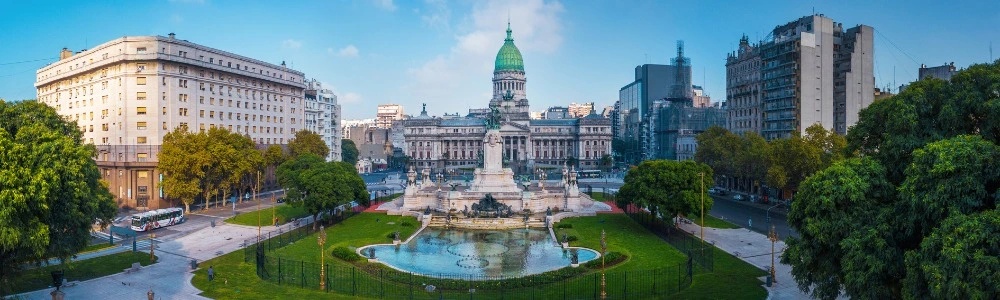
Explore world-class architecture, build international friendships, and immerse yourself in one of South America’s most lively countries with a great food and wine culture.
As one of Latin America’s top countries for higher education, Argentina is the perfect place to continue your studies. It offers everything students are looking for in a study abroad program, including language immersion, affordability, and a rich cultural experience.
Verto’s study abroad program in Argentina is currently based in the capital, Buenos Aires, with excursions venturing far beyond the city’s streets.


Dates & Deadlines
- Spring ’27: Feb. 9 – May 22 (Enroll by Jan. 11, 2027)
- Fall ’27: Late August – Early December
Reminder: Locations have limited capacity and spots can fill quickly.
Requirements
- Must be 18 by the program start date
- Valid Passport
Program Cost
- Spring ’27, Fall ’27+: $18,750 before study abroad scholarships or grants
College Credits
- 12-17 Credits from our Academic Provider, the University of New Haven
Accommodations
- Homestays, Student Residences, or Apartments (Fall Only)
HOW TO STUDY in Argentina
The good news is, Verto’s Buenos Aires study abroad program doesn’t require a student visa for U.S. passport holders.
After submitting your application to Verto, you’ll need to make sure you have your passport ready.
Passport and Entry Requirements: All students must have a valid passport for the duration of their stay. While you can enter on a tourist visa, students staying for up to six months should apply for a student visa before entering Argentina.
If you don’t yet have a U.S. passport, or need to renew your passport, read our blog: How to Apply for a United States Passport.
Student Visa Process for U.S. Citizens Entering Argentina
Reminder: Verto’s Buenos Aires study abroad program doesn’t require a student visa for U.S. passport holders.
Please note: Argentina student visas require an in-person interview at a consular location.
Current requirements for Argentina student visa (stays under six months):
- Passport and copy of passport: Provide your original passport and a copy of the photo page. Your passport must be valid for at least 6 months from your date of entry into Argentina and have at least 2 blank pages.
- Visa application form: Download the application form and fill it out completely. Sign it before submission.
- Two (2) current passport photos: 4 x 4 cm (approximately 1 ½ x 1 ½ inches) with a white background, printed in color. Applicant should be facing the camera.
- Student Certificate (“Constancia de estudiante”) verifying enrollment: Educational institutions should be registered with the National Registry of Petitioners, on behalf of Foreign Applicants of Argentina (RENURE). Hosts that aren’t registered with RENURE can call (54-11) 4317-0200/0303/0337 to complete registration.
- Letter from the university: A letter confirming your studies in Argentina with student details.
- Syllabus or study program: A copy of your study plan with courses listed.
- Proof of funds: Sufficient funds to prove you can pay for study and living expenses during your studies in Argentina. Submit a copy of your recent bank statement as proof of funds.
- Visa application fee: $150 paid to the consular office. Check with the consular office to see if they accept debit or credit cards. Many don’t accept cash or checks.
Consulate Processing Time: Consulates in the United States recommend submitting all paperwork at least two months in advance. Visa processing time may take one to two months and may be expedited in some cases.
How to Apply for an Argentina Student Visa
Student Visas for Stays Longer than 90 Days
Students hoping to study abroad longer than 90 days must apply for an Argentine student visa for courses up to one year (“Visa de estudiante -365”). (Note: this does not apply to the Verto Buenos Aires semester program, and students won’t need to apply for a visa).
To obtain an Argentine student visa, apply at your local consulate. In the United States, consulates are located in Washington, D.C.; Atlanta, Georgia; Chicago, Illinois; Houston, Texas; Los Angeles, California; Miami, Florida; and New York, New York.
Applying for a student visa outside of Argentina follows four basic steps:
Step One: Apply to a registered educational institution in Argentina.
Apply to a study abroad program in Argentina and gain admission. Receive confirmation after paying for the program and wait for an enrollment letter to submit with your visa application.
Step Two: Request a visa appointment at the nearest Argentine consulate.
Request a visa appointment at the closest consular office. This is often done by email, but specific information is available on the consulate’s website.
Most consular offices recommend submitting applications at least 45 days before your entry date in Argentina. Scheduling appointments as far in advance as possible, once you’ve received confirmation for your course, is highly advised.
Step Three: Attend your visa appointment and submit all documents.
Bring all the documentation listed above in “Current requirements for Argentina student visa” to submit. We also recommend checking the consular office website to verify what documents to bring. Pay the visa application fee and complete your interview.
Step Four: Await visa approval and have your passport stamped.
Visa processing time varies and typically takes 7 to 10 business days, though it can take longer. Once approved, you can pick up your stamped passport from the consular office.
Language: Spanish, With English – Language Academic Programming
Studying and speaking Spanish is one of the main draws of study abroad programs in Argentina (and other popular Latin American countries). You don’t need to speak Spanish to join the program.
Argentina study abroad programs, like Verto’s Buenos Aires location, currently offer Elementary Spanish I, Elementary Spanish II, Intermediate Spanish I, Intermediate Spanish II, and Advanced Spanish Conversation. Outside language classes, courses are taught in English, but students are encouraged to speak Spanish outside lessons during their semester abroad in Argentina.

Currency & Banking
Argentina’s official currency is the Argentine peso (ARS), and in recent decades, financial markets have experienced inflation volatility. This affects how travelers and students handle money.
In Argentina, cash is king, but due to the country’s financial instability, it can make it tricky to obtain. Here’s what to bring:
- Credit card for payments at shopping centers, hotels, or restaurants. Keep in mind that some
- Debit card for locations that don’t accept credit cards.
- USD to exchange for pesos. Bills must be new and crisp to exchange for pesos. (Marked or own bills will likely be refused).
- Access to Western Union to send USD to yourself to exchange for pesos. This is considered one of the best options for those staying longer than a month in Argentina.
Avoid using ATMs unless absolutely necessary, as they charge high fees and offer limited withdrawal options. Note that American Express cards are often not accepted outside of the United States.
Paying in cash usually gets you the best rate, but rates change constantly. Argentina has an official rate, “blue” market rate, and MEP (Mercado Electronico de Pagos) rate, and rates can change daily. You’ll have to check rates daily before making purchases to find out the conversion from pesos to USD.
Monthly Budget in Pesos
Many of your Argentina study abroad costs are covered by the program. These can include: accommodations, two daily meals at homestays, excursions and activities, books, course materials, emergency assistance, airport pickup, and travel medical expenses.
Monthly expenses to budget for include:
- Food and dining: You’ll cover between one and three meals per day (depending on your accommodation type). Homestays include two meals per day. Cooking at home runs roughly $150–$300 per month; budget $100–$200 for occasional dining out.
- Transportation: Public transit fares are typically under $1 per trip ($20–$60 per month depending on usage). Rideshares in city centers run about $2–$6; budget around $50 a month to cover occasional use.
- Shopping or souvenirs: This is based on your spending habits. Be honest with yourself about how much is realistic and budget between $0 and $200 per month.
- Going out (restaurants, social activities): Meeting new friends is part of the study abroad experience. Drinks at local and mid-range bars run about $2–$12. A budget of $50–$100 lets you enjoy nightlife without overspending.
- Weekend getaways: Plan ahead to keep these costs low. With hostels and local transport, budget at least $200 per weekend.
Plan to spend roughly $470 per month, with $1,110 as the high end. Please keep in mind that these prices can vary widely depending on inflation. Also plan for upfront costs like airfare and visa fees.
Time Zone
Argentina doesn’t observe Daylight Saving Time (DST), meaning in the winter (EST), Argentina is two hours ahead of the U.S. East Coast and in the summer (EDT), it’s one hour ahead.
Keeping in touch with friends and family in the United States is relatively easy, and there may be a one- to four-hour time difference between you and the U.S. during your semester abroad in Argentina.
Is Argentina Safe?
Yes! Argentina is currently considered among the safest countries in Latin America. According to the 2025 Global Peace Index, Argentina was ranked as the #1 most peaceful country in Latin America and #46 worldwide out of 163 countries.
Buenos Aires, your program base, has a low rate of violent crime, and the city runs various initiatives to keep tourists and locals safe. As with travel to any country, it’s always important to be informed, take proper safety precautions, and be aware of your surroundings.
Plus, Verto has extensive health and safety protocols and systems in place to ensure a positive and safe experience as you study abroad in Argentina. Read more about Verto’s health and safety policies.

WHAT WILL MY LIFE LOOK LIKE in Argentina
With Buenos Aires as your home base in Argentina, you can explore far beyond the capital, from the rich wine country of Mendoza to the mountains of Patagonia.
Buenos Aires itself is a cultural hotspot, known for its unique architecture and its deep love of wine and dance.
Argentinian Culture
Argentines hold a few things dear to their hearts: dancing the tango, fútbol, and time spent with loved ones (often centered around eating and drinking).
In Argentina, spending time with people is an important part of daily life; dinners start late and can run well into the early hours. Due to good weather, much time is spent outdoors in plazas, parks, or on terraces.
Excursions & Activities
Possible Study Abroad Excursions:

With Buenos Aires as your home base, you’ll have access to memorable excursions across the country. Join overnight trips to Iguazu Falls in the spring or fall, visit Bariloche, or venture to Peninsula Valdes in the fall.
Day trips can include visits to the Tigre Delta and Colonia, Uruguay, as it’s just across the water from Buenos Aires. You can also sign up for cultural events such as traditional mate-drinking ceremonies and fútbol matches to truly immerse yourself.
Excursion availability is subject to change.


Accommodations
& Meals
Find your home base in Argentina
Study abroad participants can choose the living arrangement that feels right for them, whether that’s immersing in local culture with a host family through a homestay, or living alongside fellow Verto participants in student residences. Note: Apartment housing is only available during fall semesters.

WHERE YOU’LL STUDY: BUENOS AIRES
Your study abroad program is based in Buenos Aires, Argentina, the vibrant heart and cultural center of the country.
ACADEMICS in Argentina
Earn transferable college credits from the University of New Haven (Verto’s Academic Provider) during your study abroad program in Argentina.
Intimate Class Sizes with Professors Who Care: Verto participants receive personalized lessons and engagement, with class sizes averaging 16 students.
Hands-On Learning and Enriching Excursions: Classes extend beyond the “traditional classroom” through immersion in Argentina’s culture and history, featuring hands-on experiences and activities.
Academic Support & Advising: Students receive consistent support with access to 1:1 guidance and resources, including tutoring and study groups.
Course Information
Advanced Spanish Conversation
This advanced course is designed to focus on students’ interpersonal, interpretative, and presentational skills, while helping them further develop their spoken level of proficiency in Spanish. Students will be exposed to the cultural diversities of the Spanish-speaking countries by means of a broad range of topics, readings, musical recordings, and films. All these elements will spark students’ imagination, will generate controversy for in-class debates, and will provide the opportunity to practice the linguistic skills needed for oral and written communication (listening comprehension, writing, reading comprehension, and socio-cultural competence).
Calculus I
The first year college course for majors in mathematics, science and engineering; and the basic prerequisite for all advanced mathematics. Introduces differential and integral calculus for functions of one variable, including algebraic and transcendental functions and culminates in the fundamental theorem of calculus. Includes basic rules and properties of limits and derivatives and applications of derivatives. Studies the plane analytic geometry needed for calculus.
Cultural Anthropology
A systematic study of the culture of preliterate and modern societies and of cultural change. Includes analyses of religion, economics, language, social and political organization and urbanization.
Cultural Understanding of Food and Cuisine
The importance of food and cuisine within the context of society. This course will explore the impact of food on the evolution of mankind and address issues relating to the importance of food in the political and economic structure of the world. Questions regarding food supplies and sources as well as ethical questions facing mankind in the near future will be examined. Also explored will be the influences and perceptions of food in different cultures of the world and how those perceptions affect intercultural understanding.
Elementary Spanish I
Focuses on the fundamental principles of grammar. Extensive vocabulary and pronunciation exercises.
Elementary Spanish II
Focuses on the fundamental principles of grammar. Extensive vocabulary and pronunciation exercises. Aural comprehension and pronunciation are tested by oral examination.
Elementary Statistics
Topics include: basic probability theory; random variables and their distributions; estimation and hypothesis testing; regression; and correlation. This course is not calculus-based, and places an emphasis on an applied approach to statistical theory with applications chosen from the biological sciences and other fields of study. Students will be introduced to and make use of a computer package for data analysis.
Entrepreneurship
Covers the entrepreneurial process from conception to operation of a new enterprise. Concentrates on the characteristics of entrepreneurs and the process by which they turn creative ideas into a new enterprise. The emphasis will be on how entrepreneurs can create value for themselves, their investors, their immediate communities, and other stakeholders.
Environmental History
This course investigates the development of natural and built environments in modern times. The problems of global warming are a recent manifestation of environmental problems. Institutional, cultural, and political changes came with the construction of cities, industries, and infrastructures, resulting in problems with air, water, land, and energy. These local and global environmental issues may reflect an unsustainable relationship with nature.
Ethics
How shall one live? Critical examination of answers proposed by classic and modern philosophers of the major world traditions.
Foundations for Success
Foundations for Success is a unique one-credit course designed with the purpose of guiding students through the transition between high-school and college life. With a focus on developing essential skills that are integral for success both in and beyond the classroom, this course will equip first-year students with the tools necessary to thrive academically, socially, and personally. Our holistic approach recognizes the importance of intellectual, emotional, social, ethical, and physical development, making this course a powerful tool for growth and self-awareness. Through interactive coursework, students will learn how to cultivate lifelong learning skills, foster community, build resilience, and achieve personal success at every level.
Foundations of Leadership
This course introduces students to the history of leadership and provides the opportunity to explore leadership theory and concepts through the six competencies of the Competency Learning Experience (CLE): (1) leadership, (2) communication, (3) resilience, (4) teamwork, (5) global and cultural awareness, and (6) critical thinking. Through engagement with interactive assignments, case studies and class discussions, students will develop skills to improve their understanding of leadership and how to be effective leaders in their organizations, teams, communities, and careers.
Globalization of Sport
Sport is a universal element in all cultures. It is a key to social identification and building cultural capital. With the globalization of sports and commercialization of international sports, sports have been utilized as a soft power. This course focuses on the role of sport in global society. Throughout the course, students compare traditional and modern-day sports in different regions of the world to gain an understanding of the role sports play in various cultures. Students also engage with geographic and sociopolitical histories through exposure to international sport events.
History of Art II
This course introduces students to works of art from the Renaissance period to the mid-20th century. The course explores the expressive, social, cultural, political, economic, and technological aspects of societies as reflected in their art.
Intermediate Spanish I
Stresses the reading comprehension of modern prose texts and a review of grammar necessary for this reading. Students are encouraged to read in their own areas of interest.
Intermediate Spanish II
Stresses the reading comprehension of modern prose texts and a review of grammar necessary for this reading. Students are encouraged to read in their own areas of interest.
Introduction to Environmental Science w/ Lab
Today’s environmental problems have scientific, social, and political aspects to them. This course, which is required for majors and is suitable for non-majors, will focus on the scientific aspects but will not ignore the other two. The student will be introduced to the geology, biology, physics, and chemistry behind the problems and to the social and political difficulties inherent in dealing with them. Through a combination of lectures, case histories, in-class discussions, and observation of the environmental decision-making process at work, the student will gain an understanding of the complex nature of environmental problems and of the choices that must be made in solving them.
Introduction to Microeconomics
Microeconomics including markets and market structure and the allocation of resources. The distribution of income, the public economy, the international economy, and selected economic problems.
Introduction to Music
Basic forms and styles of music in the Western World; music appreciation.
Introduction to Philosophy
The nature of reality and how it may be known, according to the great thinkers of the West and the East.
Introduction to Psychology
This course will provide students with a basic understanding of psychology as a science. It will introduce students to research methods, principles of learning, development, biological bases of behavior, psychological disorders, and social psychological phenomena. Additional topics may include cognition, sensation and perception, sleep, intelligence, and personality. Ethical issues within the field will also be examined.
Making Modern Latin America
Latin American nations formed as people around the world worked out what modern ideals like freedom and equality meant in the context of multicultural countries. In this class, students will engage with various historical methods and sources-with a focus on primary sources-to investigate how Latin American leaders and citizens balanced their desires for political ideals like equality and democracy and pressures to create modern industrial economies from the vestiges of colonial rule and ongoing imperial pressures. In addition to a basis for understanding modern Latin America, students will leave this class with solid experience analyzing documents and data that they can apply to future classes or their careers.
Politics of Globalization
This course will provide students a clear understanding of the emerging trends of globalization with a special focus on what led to the beginning of these trends and what are its current patterns. The course will also focus on the most recent “global flows” and their impact including global economic flows as reflected in the growing international trade, global political flows as observed in the internationalization of political issues, global cultural flows as discerned through cultural convergences, and global technological flows as witnessed by the internet revolution. In addition, the course will study the politics of globalization with an analysis of the differential impact of globalization on the developing and the developed world.
Pre-Calculus
Topics include: polynomials; algebraic functions; plane analytic trigonometry; and properties of exponential, logarithmic, and trigonometric functions. This course offers the foundation needed for the study of calculus.
Principles of Marketing
The fundamental functions of marketing involving the flow of goods and services from producers to consumers. Marketing methods of promotion, pricing, product decisions, and distribution channels.
Quantitative Reasoning
Topics include: sets; basic logic; enumeration and elementary probability; mathematical applications of personal finance; and basic statistics.
Seminar in Academic Inquiry and Writing
This course introduces students to the conventions of academic writing and the habits of critical inquiry they will need in university courses and beyond. Students read and annotate texts on a topic (or topics) selected by the instructor, develop original avenues of inquiry through classroom discussion, and transform their questions into well-supported academic arguments. Assignment sequences incorporate opportunities for research, drafting, revision, editing, and reflection to help students find writing processes that can be replicated in future courses and workplace projects that require only polished work. Because different disciplines and career paths present different scenarios for critical thinking and writing, this course also teaches students how to adapt the conventions of academic inquiry to a variety of contexts.
Advanced Spanish Conversation
This advanced course is designed to focus on students’ interpersonal, interpretative, and presentational skills, while helping them further develop their spoken level of proficiency in Spanish. Students will be exposed to the cultural diversities of the Spanish-speaking countries by means of a broad range of topics, readings, musical recordings, and films. All these elements will spark students’ imagination, will generate controversy for in-class debates, and will provide the opportunity to practice the linguistic skills needed for oral and written communication (listening comprehension, writing, reading comprehension, and socio-cultural competence).
Elementary Spanish I
Focuses on the fundamental principles of grammar. Extensive vocabulary and pronunciation exercises.
Elementary Spanish II
Focuses on the fundamental principles of grammar. Extensive vocabulary and pronunciation exercises. Aural comprehension and pronunciation are tested by oral examination.
Elementary Statistics
Topics include: basic probability theory; random variables and their distributions; estimation and hypothesis testing; regression; and correlation. This course is not calculus-based, and places an emphasis on an applied approach to statistical theory with applications chosen from the biological sciences and other fields of study. Students will be introduced to and make use of a computer package for data analysis.
Entrepreneurship
Covers the entrepreneurial process from conception to operation of a new enterprise. Concentrates on the characteristics of entrepreneurs and the process by which they turn creative ideas into a new enterprise. The emphasis will be on how entrepreneurs can create value for themselves, their investors, their immediate communities, and other stakeholders.
Ethics
How shall one live? Critical examination of answers proposed by classic and modern philosophers of the major world traditions.
Globalization of Sport
Sport is a universal element in all cultures. It is a key to social identification and building cultural capital. With the globalization of sports and commercialization of international sports, sports have been utilized as a soft power. This course focuses on the role of sport in global society. Throughout the course, students compare traditional and modern-day sports in different regions of the world to gain an understanding of the role sports play in various cultures. Students also engage with geographic and sociopolitical histories through exposure to international sport events.
Intermediate Spanish I
Stresses the reading comprehension of modern prose texts and a review of grammar necessary for this reading. Students are encouraged to read in their own areas of interest.
Intermediate Spanish II
Stresses the reading comprehension of modern prose texts and a review of grammar necessary for this reading. Students are encouraged to read in their own areas of interest.
Introduction to Macroeconomics
Foundations of economic analysis, including economic progress, resources, technology, private enterprise, profits, and the price system. Macroeconomics including national income, employment, and economic growth. Price levels, money and banking, the Federal Reserve System, theory of income, employment and prices, business cycles and problems of monetary, fiscal, and stabilization policy.
Introduction to Psychology
This course will provide students with a basic understanding of psychology as a science. It will introduce students to research methods, principles of learning, development, biological bases of behavior, psychological disorders, and social psychological phenomena. Additional topics may include cognition, sensation and perception, sleep, intelligence, and personality. Ethical issues within the field will also be examined.
Making Modern Latin America
Latin American nations formed as people around the world worked out what modern ideals like freedom and equality meant in the context of multicultural countries. In this class, students will engage with various historical methods and sources-with a focus on primary sources-to investigate how Latin American leaders and citizens balanced their desires for political ideals like equality and democracy and pressures to create modern industrial economies from the vestiges of colonial rule and ongoing imperial pressures. In addition to a basis for understanding modern Latin America, students will leave this class with solid experience analyzing documents and data that they can apply to future classes or their careers.
Politics of Globalization
This course will provide students a clear understanding of the emerging trends of globalization with a special focus on what led to the beginning of these trends and what are its current patterns. The course will also focus on the most recent “global flows” and their impact including global economic flows as reflected in the growing international trade, global political flows as observed in the internationalization of political issues, global cultural flows as discerned through cultural convergences, and global technological flows as witnessed by the internet revolution. In addition, the course will study the politics of globalization with an analysis of the differential impact of globalization on the developing and the developed world.
Seminar in Academic Inquiry and Writing
This course introduces students to the conventions of academic writing and the habits of critical inquiry they will need in university courses and beyond. Students read and annotate texts on a topic (or topics) selected by the instructor, develop original avenues of inquiry through classroom discussion, and transform their questions into well-supported academic arguments. Assignment sequences incorporate opportunities for research, drafting, revision, editing, and reflection to help students find writing processes that can be replicated in future courses and workplace projects that require only polished work. Because different disciplines and career paths present different scenarios for critical thinking and writing, this course also teaches students how to adapt the conventions of academic inquiry to a variety of contexts.
INCLUDED WITH Your Experience
We recommend budgeting $700-900 USD per month for personal expenses. Your budget will mostly depend on your spending habits, especially for independent travel.
Talk to your family about budgeting expectations before you arrive. You don’t want to blow your whole budget on empanadas! (Or do you…?!)
Included With Your Study Abroad Program
- All accommodation while overseas
- 2 meals per day (homestays only)
- All scheduled activities, excursions, and events
- Books and other course materials
- Travel medical insurance
- Airport pickup on the designated arrival date
- 24/7 emergency assistance
International airfare, change fees, visa and passport fees, public transportation, and meals at residences and apartments are not included.
Check out these Vertoan’s tips on keeping to your budget while abroad!
Scholarships & Institutional Aid
At Verto, we believe studying abroad should be accessible to everyone, regardless of your financial background.
Around half of Verto participants have study abroad scholarships, institutional aid, or both.
Verto’s Global Citizen Scholarship can greatly reduce study abroad expenses and is available to eligible participants. You can also apply for external grants and scholarships to help cover your study abroad costs.
How to Apply to Verto and Study in Argentina
Applying to Verto is simple. Fill out our free study abroad application in a few minutes. After applying there’s no obligation to attend, but you can explore our programs to learn more about studying abroad.
Upon submission, we’ll match you with a counselor to answer all your questions.
Start your application and explore Argentina today!
FREQUENTLY ASKED Questions
No, you don’t need to speak Spanish to study in Argentina. You can easily sign up for Spanish courses at your level during a Verto study abroad program.
Studying abroad in Argentina is less expensive than many countries, but it also depends on your personal spending each month. Verto Education’s study program in Argentina is more affordable than programs in the Czech Republic, Spain, England, and Italy.
Yes, Argentina is considered safe for students from the United States to study abroad. Currently, it’s ranked as the safest country in Latin America and the Caribbean.
Studying abroad is a personal choice, and for many students, studying during their first year is a smart decision that sets them on a path to global connections and relationships.
No, the only difference between studying at a home university in the US and studying abroad in Argentina is the application process and timeline, and there may be a difference in costs.


